


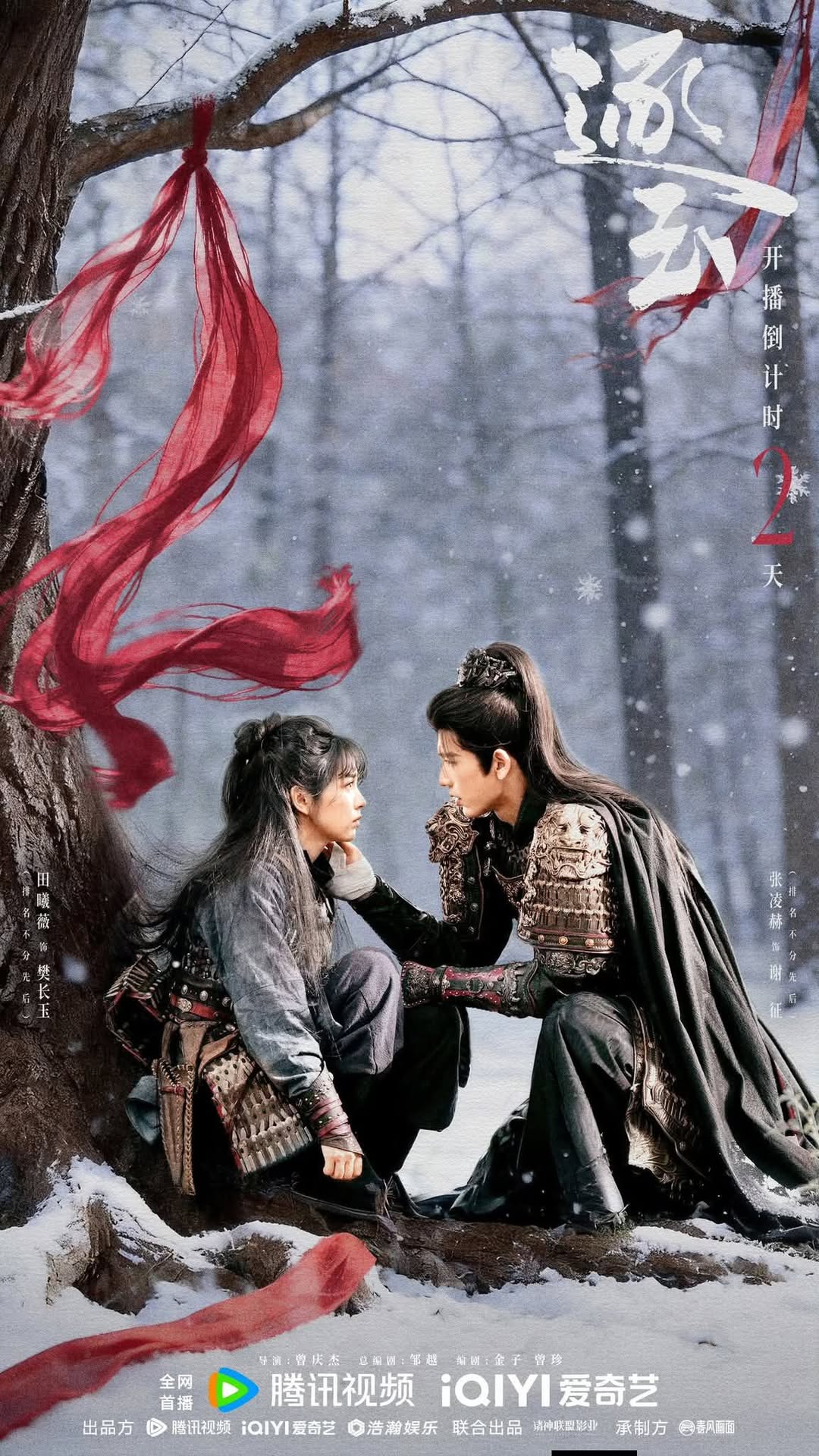
If there is one problem that many dramas suffer from, but Pursuit of Jade resolves in an almost brilliant way, it’s the opening. The story wins you over within the first few minutes, making you fall in love with the protagonist immediately.
The Lin’an County arc, which spans roughly 15 to 16 episodes, is responsible for drawing you deeply into the characters in a way I hadn’t felt in a long time.
The storytelling is so solid that you find yourself wishing the story would never leave that place. Everything feels warm and well-paced, functioning as a perfect foundation for everything that follows. It’s the kind of material you’d want to revisit just for that section alone.
The premise is also a major differentiator. Fan Changyu is the daughter of a butcher, which breaks entirely from the common drama template in which the female lead tends to be noble, of royal lineage, or a helpless maiden.
Here, we have a strong, determined woman who is no less feminine, beautiful, or romantic for it. That said, there is one thing that bothers me: as tends to happen with many stories featuring strong, warrior women, she ends up being portrayed as someone who doesn’t value learning or demonstrate intellectual depth. This applies to Fan Changyu as well.
It’s not something that undermines the work as a whole, but it would be refreshing to see a character who combines all of those qualities and also stands out intellectually.
I understand this may be an attempt to avoid the Mary Sue effect, but it is entirely possible to write a character who is both strong and intelligent without making her perfect—it’s precisely her flaws, after all, that make a person feel real.
Back to the story: at the beginning of the drama, Fan Changyu rescues a stranger in the snow and ends up marrying him out of necessity. From there, the relationship between the two grows organically, and the couple’s chemistry carries a significant portion of the series, landing especially well in the moments that matter.
Tian Xiwei delivers an incredible performance as Fan Changyu. Her growth as an actress is visible throughout, and watching the character’s journey—from a humble butcher to a great general—is genuinely satisfying.
It’s the kind of female arc that doesn’t appear often enough in Chinese historical dramas.
Zhang Linghe is equally convincing as both the ruthless Marquis Wu’an and the gentle Yan Zheng. These are distinct personalities, and he moves between them with ease, creating a male lead with real depth and complexity.
The supporting cast also holds up well. Yan Yikuan, in the role of Wei Yan, is one of the series’ biggest surprises. His character occupies an ambiguous space, closer to an anti-hero than a villain, and the performance gives him genuine weight.
On top of that, his physical resemblance to the actor playing Xie Zheng is striking—clearly a casting decision director Zeng Qingjie got right.
Around the midpoint of the series, however, the narrative begins to lose momentum. The military camp arc had the potential to explore months of cohabitation, battles, and tension, but what we mostly get is a repetition of the plotline in which Xie Zheng conceals his identity.
This becomes tiresome, as the reveal is drawn out far longer than necessary. It doesn’t shatter the immersion entirely, but it makes the pacing feel more sluggish than it should.
There are also moments when the story rushes forward without warning. Significant characters die without adequate explanation, and certain events appear abruptly, as if entire scenes—or even full arcs—had been cut. Episode count limitations and possible external interference, such as censorship, likely played a role in these decisions.
The final arc is, without a doubt, the series’ weakest point. Resolving the central conflict through dreams and convenient discoveries feels lazy. Compounding this is the lack of emotional depth given to Xie Zheng, particularly regarding his family and his past.
He is such a well-constructed character, with so many layers, that this absence of development is genuinely frustrating. The same applies to the revelation surrounding Fan Changyu’s true identity and family background, which falls far short of the expectations built up across the series.
Another issue lies with the secondary couples—particularly Qi Min and Yu Qianqian. They receive screen time that never quite justifies their role in the narrative, with scenes that contribute little to the story’s overall development.
In many moments, it feels as though the show is trying to force the audience to care about them. The dynamic between the two, marked by a confusing push and pull between rejection and affection, borders on something resembling Stockholm syndrome, which makes the whole thing even more frustrating.
Meanwhile, scenes featuring the main couple—Fan Changyu and Xie Zheng—that were clearly filmed didn’t make it into the final cut. This is particularly disappointing because the heart of the series lies precisely in their relationship.
Had the story been told primarily from their perspective, without so many interruptions from other storylines, the result would likely have been even more powerful. In the early episodes, when the focus rests almost entirely on the couple, the storytelling is engrossing and nearly flawless. Once other subplots are introduced in excess, the pacing unravels.
The soundtrack, on the other hand, is a genuine triumph. The music builds a consistent atmosphere and functions as an emotional trigger for the scenes it accompanies.
The production overall is notably careful: the costumes are elaborate, the cinematography is polished and memorable, and it manages to disguise the use of CGI quite effectively. The direction, for its part, knows how to make the most of its actors.
And I return once more to the Lin’an arc. It is, by a wide margin, the best stretch of the series. Had the narrative maintained that same approach throughout, this drama would likely rank among the best I’ve ever watched.
There is something nostalgic and comforting in the simplicity of everyday life—the small interactions, the domestic routines of the protagonists—that stays with you. It never feels drawn out or slow; on the contrary, something is always happening, and all of it is deeply engaging. It has the quality of a place that could actually exist.
In the final assessment, Pursuit of Jade is a series that suffers from external interference with its screenplay and from an attempt to expand its scope too aggressively—particularly in its investment in palace intrigue and in giving excessive depth to villains like Qi Min.
The intention to avoid one-dimensional antagonists is valid, but the execution goes too far, dedicating too much time to these characters at the expense of the main couple. Simply showing their actions, consequences, and impact on the protagonists’ lives would have been enough to achieve the intended effect.
Even so, despite its stumbles, this is a very good Chinese historical drama—perhaps one of the best within this particular style, excluding the isekai subgenre.