


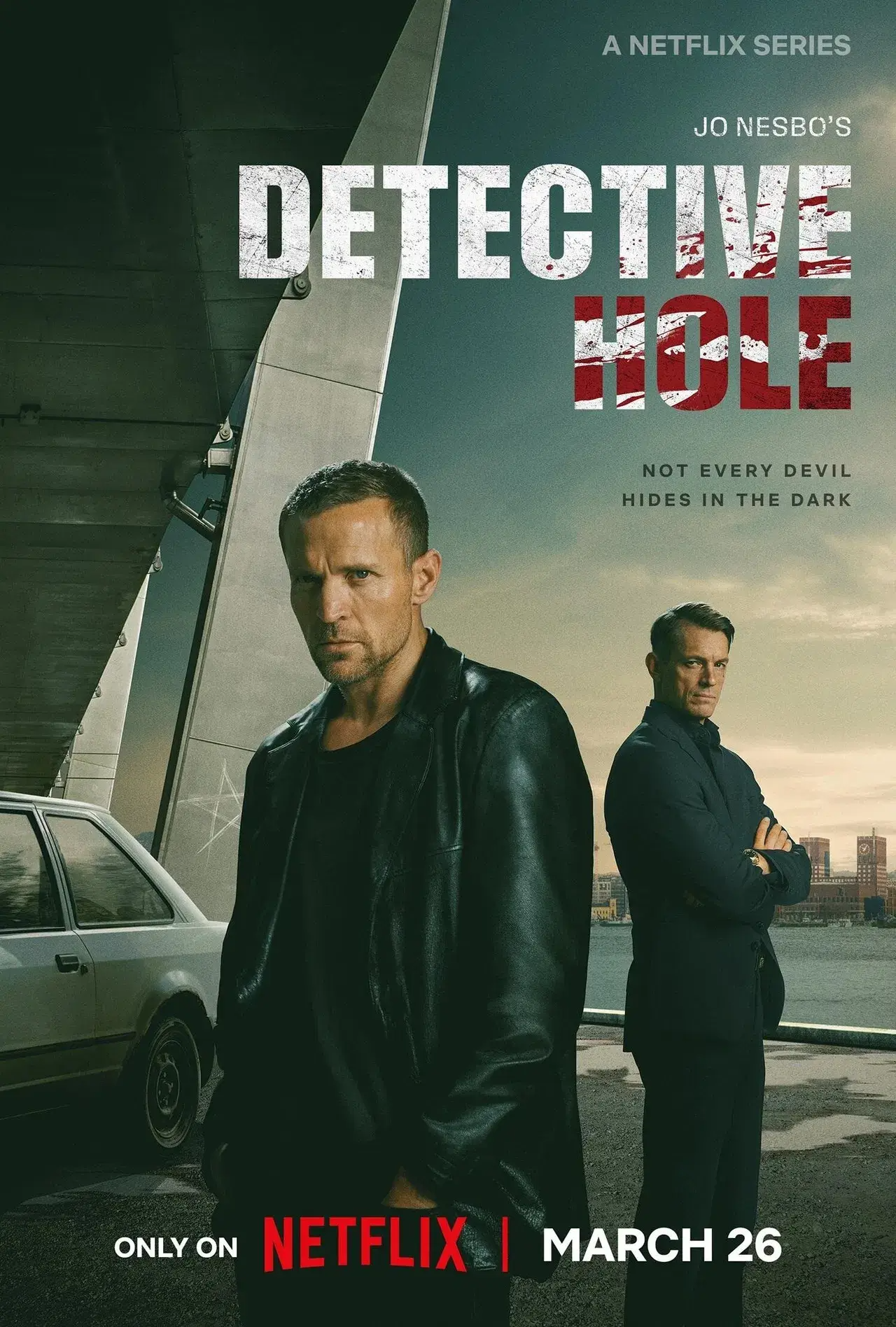
I’d never read anything by Jo Nesbø before, so I had zero background on the Harry Hole series or the cases unfolding in Oslo.
Honestly? That might have been the best way to go in blind. I found myself completely absorbed in a story that turns the Norwegian capital into something like a Nordic Gotham — dark alleys, homeless encampments, and sunlight so sickly yellow it feels diseased.
That’s the world Harry Hole operates in, and it’s nearly impossible not to get hooked with every new development. Sure, Netflix’s usual expository problems are still lurking around. But because Jo Nesbø himself was directly involved in this adaptation, a lot of the platform’s most annoying habits — storylines that spin their wheels so nothing actually happens until the final episodes, bloated runtimes designed to inflate watch hours, content engineered as background noise for people scrolling their phones — are largely kept in check here.
There’s enough going on, enough clues and deliberate narrative decisions, that if you’re not paying attention, you’ll miss things. That alone puts this series well above the average Netflix crime drama. Add the thick noir atmosphere, and I was hooked enough to seriously consider tracking down Nesbø’s books.
From what I gathered, the series adapts The Devil’s Star, the fifth book in the Harry Hole saga. It opens with two tangled storylines that feel disconnected at first — but by the end, everything clicks into place and explains how each piece of the puzzle got there.
One thread follows a serial killer who leaves victims with a red diamond tucked under their eyelid. The other centers on a corrupt cop who needs to be brought down. There’s also a disappearance case that gradually unravels as part of the murder spree. Two narrative threads running in parallel — and the series manages to keep both from losing momentum.
That said, I’ll be honest: there were moments where I lost track of which thread was supposed to matter more. The show stumbles slightly in those beats, though not badly enough to derail the overall picture.
Harry Hole himself is your classic anti-hero — brilliant, alcoholic, and relentlessly self-destructive. The character works.
What genuinely surprised me was learning that Nesbø didn’t just sign off on the show — he wrote every single episode himself. The result is something remarkable. Every character has a depth that only the original creator could pull off. He didn’t hand the wheel to Hollywood, and you feel his authorial control throughout. That said, certain plot resolutions and the way some threads connect can feel a little murky in the moment.
By the end, everything makes sense — but I won’t pretend there weren’t stretches where I felt genuinely lost, and not in a satisfying way. That’s worth flagging.
The soundtrack deserves its own mention. The music curation feels like Harry himself put the playlist together — it fits the show’s grim atmosphere without ever feeling forced.
Oslo here is not the postcard city. The production builds a metropolis full of rotten corners, gang warfare, and a constant sense that anything could go wrong at any second. The color palette is heavy — deep navy, clinical green, muddy brown. Natural light exists mainly to cast shadows. It’s cinematography fully in service of the story, delivering every bit of the noir atmosphere this material deserves.
The ritualistic murders are unsettling in exactly the right way. There’s no gratuitous gore for shock value — there’s a dark internal logic to every scene, and the show uses that to keep tension high without resorting to cheap tricks. It’s twisted, stylized, and at certain moments gloriously bleak.
Every episode ends on a cliffhanger. I genuinely tried to stop and sleep. I couldn’t. Nearly every episode closes with a hook that makes hitting “next episode” feel involuntary. This show was built to be binged, and it delivers on that completely.
One thing worth flagging: nine episodes at nearly an hour each is a lot, and around the middle of the season the show visibly loses some steam. That’s probably where Netflix pushed to stretch the runtime and pad the watch hours. It doesn’t sink the experience, but it’s a real stumble.
If I’m being honest, six tight episodes would have made this something close to flawless.
It’s worth comparing to another recent noir gem — Slow Horses — which pulls off exactly that: a clean, contained story told in just a few episodes, leaving you with the feeling of a perfect little object. Harry Hole doesn’t quite achieve that. A few unnecessary detours in the back half create some friction. Don’t be surprised if episode five feels like it’s running in place.
If you’ve never read the books — like me — you’re fine. The show stands on its own, introduces its world without resorting to clunky info-dumps, and makes it clear there’s plenty more story where this came from. For readers looking for faithfulness to the source material, with Nesbø himself at the controls, I’d bet the adaptation does right by the books.
Harry Hole is exactly what a Nordic thriller should be: dense, unpredictable, genuinely unsettling, and populated by characters with real weight. It’s easily one of the best crime series Netflix has put out in years.