


Now I have all the confirmed English titles. Here’s the translation:
In September 1987, in Goiânia, a cesium-137 capsule containing less than 20 grams of radioactive material ended up generating 6,000 tons of toxic waste, four immediate deaths, and at least a hundred more in the years that followed.
It’s no coincidence that this is the worst radiological accident in history outside a nuclear power plant — and it happened in Brazil. That’s the premise Netflix’s Radioactive Emergency builds its entire story around.
To set the stage, the show rewinds to the moment two scavengers stumble upon a metal capsule weighing around 440 pounds inside an abandoned radiotherapy machine. At first glance, it looks like a rare score — literally a gold mine, since the casing is lead and could fetch a decent price. The catch, of course, is that the real danger is sealed inside, completely invisible to them.
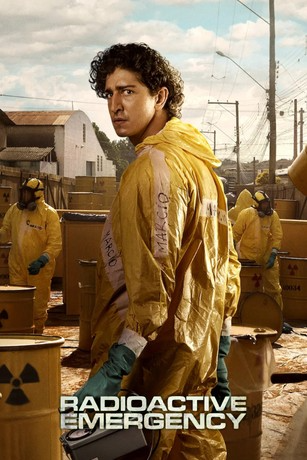
From there, the series widens its lens and introduces us to Márcio, played by Johnny Massaro with a quiet, restrained energy that works really well here. He’s a young nuclear physicist who is only passing through Goiânia but gets pulled into the heart of the crisis when a doctor friend starts noticing that patients showing up at the hospital have symptoms consistent with radiation poisoning.
The structure the show builds on that setup alternates between the disaster spreading and the desperate attempt to understand it — and along the way, it delivers some genuinely strong scenes and moments. That said, to be honest, this is a series that struggles pretty hard with inconsistency. Some stretches hit: the dialogue lands, the cinematography is sharp, the performances carry weight. But other parts lose the thread completely, sliding into something schmaltzy and, at times, almost cartoonish.
That unevenness becomes especially obvious whenever the story dips into the political and crisis-management side of things. The clashes between the team analyzing the cases, the authorities, and the local press have real potential — but they rarely find the muscle to back it up, and those scenes end up feeling like missed opportunities.
On the flip side, whenever the show shifts its focus to what actually matters — the patients — it nails it. You feel the pain, the suffering, the danger, and, above all, the gut-wrenching urgency of a race against time to save people in a situation that had absolutely no medical playbook.
The comparison to Chernobyl comes up almost naturally in that context, partly because the show itself keeps bringing it up. Still, what happened in Goiânia has a dimension all its own, and in many ways, what the cesium-137 victims went through doesn’t even have a direct parallel.
That’s where the series hits its most devastating note — at the human level. There’s a scene where the junkyard owner hands out the glowing powder to friends and family that just breaks you. He has no idea he’s passing around something with serious potential to kill. To him, it’s beautiful. A husband decorates his wife with the powder. A father tries to give his little daughter something that looks like stars. A neighbor places it on her home altar as if it’s something sacred, almost a divine blessing.
The tragedy lands even harder because of that. It makes it brutally clear that everything was set in motion by innocence, by ignorance — and, above all, by the negligence of the state. That’s what actually breaks your heart.
At the same time, while the show manages to be genuinely moving, it also leans way too hard into hand-holding. Following a pattern Netflix has been guilty of lately, there’s a constant need to explain what’s already being shown on screen. Characters who are clearly experts in their fields end up spelling out information to each other that, given who they are, would be completely obvious. It’s understandable as a way to bring the audience along, but the thing is — the context alone would have carried it. Without all the over-explaining, the story would have held up just fine. These are creative choices that end up undercutting the impact of scenes that could have hit much harder.
The inevitable comparison here is with Chernobyl, the HBO miniseries. Financially, it’s an unfair fight — but conceptually, it’s a fair one. In that show, the disaster is framed as the unavoidable result of a broken system rotting from the inside out, on the verge of collapse.
Radioactive Emergency never quite gets there. You walk away with the feeling that there was a denser, sharper version of this story waiting to surface. What’s missing, ultimately, is that sense of systemic inevitability. The tension between the public and the authorities, between science and politics, between common sense and institutional negligence — it’s all present, but it never gets a visual or narrative treatment that actually gives it weight. Everything ends up feeling more surface-level than it needed to be. In many moments, the show seems to reach for something more complex, then pulls back, almost like it doesn’t trust itself to go there. And that’s exactly where its weakest spots show — the parts that tip into caricature and break the consistency of the whole thing.
In the end, Radioactive Emergency is still a solid miniseries — and, more than anything, a necessary one. It rescues a piece of history that Brazil spent nearly 40 years trying to leave behind, and honestly, that alone is reason enough for it to exist and to earn every one of its five episodes.