


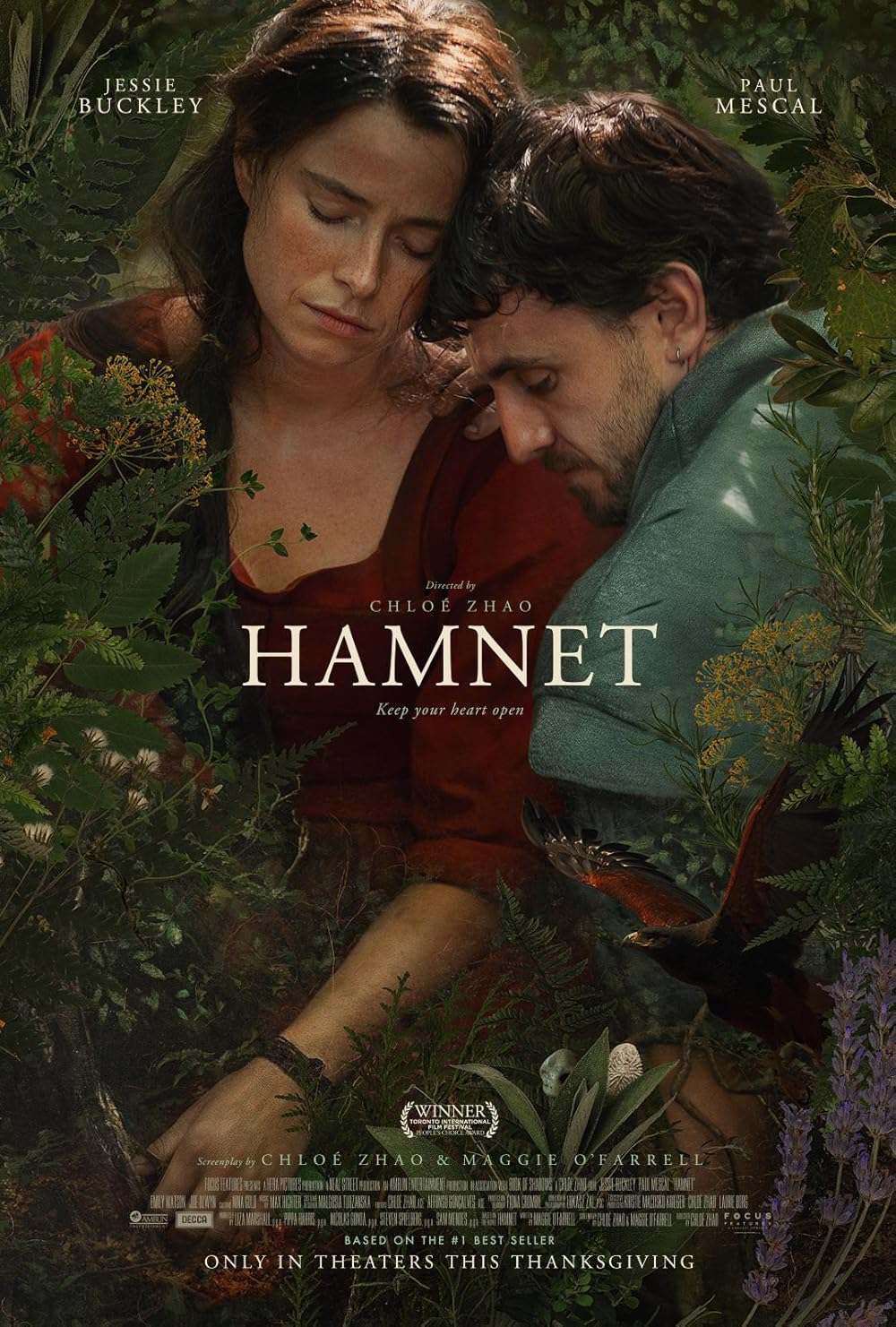
Hamnet might be one of those movies you go into already expecting to be good — and somehow, even with all that anticipation, nothing really prepares you for what you actually end up watching, or for that feeling sitting in your chest once the credits roll.
The story follows a couple trying to build a family in a time when death was practically a neighbor, when a simple flu could wipe you out. That’s the world their family grows up in. Children are born, life keeps moving, and then one of them is gone.
And that’s when the film leans all the way into the idea of a drama worthy of William Shakespeare. Literally — because that’s exactly who this is about. This is William Shakespeare’s personal story, his grief, and especially the story of his wife, who the film calls Agnes. And it’s Agnes who carries every single frame of this thing.
Chloé Zhao, the same director behind Nomadland, delivers a film that is in absolutely no hurry. She builds each scene like it’s a ritual. Every detail is deliberate, every quiet moment earns its place, and the whole thing comes together into something that borders on perfect.
But back to who this story actually belongs to: Agnes. What a character. What a woman. What a lead. Even though Shakespeare is technically one of the protagonists, he fades into the background next to her — she owns the entire film. Jessie Buckley gives one of the best performances I’ve seen in years, maybe in the whole decade.
And it becomes most obvious in the scenes where she doesn’t say a single word. No dialogue, nothing. But she is so magnetic, the way she moves, the way she fills a room, the way she pulls your attention completely toward her, that honestly the whole film could’ve just been her monologues and it still would’ve been a masterpiece.
Paul Mescal does what he does best — quiet, melancholic, emotionally heavy — but with an extra layer here. His Shakespeare isn’t some untouchable genius up on a pedestal. He’s a broken man trying to piece himself back together, and the camera just sits with him, watching without judgment. He gets sidelined though, and rightfully so, because this was never really his story.
What surprised me most was the film’s refusal to explain itself. It never shouts, “Hey, look, this is where Hamlet comes from.” It just plants the connections and trusts you to make them yourself. There’s a real respect for the audience’s intelligence there, and the one moment where the film does let the dots connect, it happens because the characters themselves need it — which is exactly what the final act delivers. And that’s when you realize how precisely every single scene was written.
The cinematography is mostly still. When the camera does move, it moves for Agnes. When it stays put, it’s like you’re sitting in theater seats watching Will from a distance. That distinction seems small on paper, but it completely changes how you feel about each of them.
And the sound design is haunting — no silence in this film is actually silent. The wood creaks. The wind moans outside. You get this constant sense that something is about to happen, like a Shakespearean tragedy is always just one moment away from arriving.
There’s also this persistent undercurrent of danger even before the loss hits. Agnes is treated like a witch by the people around her, and the camera frames her that way too, like she’s something between human and otherworldly. It builds a tension that never fully lets go.
Then the third act lands, and everything clicks into place. What Zhao does with Agnes watching Hamlet in that theater — that sequence is one of the most powerful things cinema has given us in years. She starts resistant, almost offended that this could be honoring her son’s memory, and by the time it ends, both she and you are crying for the hole that Hamnet left — in the story, and right in the middle of your chest.
Is it flawless in the sense that everyone agrees? No. Some people will find it slow. Some will call it melodramatic. That’s fair. It’s genuinely the kind of film that divides people.
But what Hamnet does with the idea of art is unlike anything else. It doesn’t romanticize the creative process. It shows that real creation is an urgent response to pain — sometimes a solitary, consuming one. The kind that can pull an artist so far inward that they end up being someone capable of connecting millions of people while somehow losing the ability to connect with anyone standing right in front of them.